Detailed Review
Azul stands as the undisputed champion of the mobile tile-strategy genre. Adapted from Michael Kiesling's award-winning board game, the digital version captures every nuance of the original while adding the convenience and polish that only a well-crafted mobile port can deliver. From the moment you open the app, you are greeted by a gorgeous presentation that pays homage to the Portuguese azulejo tiles that inspired the game's theme. The attention to detail in the tile textures, the subtle shading on the factory displays, and the satisfying animations when tiles slot into your pattern wall all contribute to an experience that feels genuinely premium.
The core gameplay loop is elegantly simple yet endlessly deep. Players take turns drafting coloured tiles from shared factory displays, placing them onto staging rows on their personal board. Once a row is complete, a single tile slides into the corresponding position on the mosaic wall, scoring points based on adjacency. Any surplus tiles spill into the penalty row, costing precious points. This push-and-pull between greed and caution forms the beating heart of Azul's strategic appeal, and it translates beautifully to the touchscreen format where a single tap-and-drag is all it takes to execute a move.
Where Azul truly excels on mobile is in its multiplayer implementation. Online matchmaking connects you with opponents across the globe, and the asynchronous play mode means you can maintain several concurrent games without feeling rushed. The real-time mode is equally well-tuned, with responsive servers and minimal latency even on modest mobile data connections. Local pass-and-play remains an option for shared-device play, though the online experience is where most players will spend their time.
The AI opponents deserve special praise. Ranging from a forgiving beginner level that teaches through example to an expert tier that plays near-optimally, the computer opponents provide a genuine practice ground for honing your skills. The hardest AI will actively hate-draft tiles to deny you key pieces, mirror advanced scoring strategies, and punish overcommitment to a single colour. Playing against it repeatedly is the fastest way to improve your competitive play.
Azul is not without minor flaws. Matchmaking can slow during off-peak European hours, and the absence of a colourblind mode at launch was a notable accessibility oversight (since patched). Expansion content such as the Stained Glass of Sintra and Summer Pavilion variants are sold as separate in-app purchases, which may frustrate players who expect a complete package from the base price. These are small blemishes on an otherwise outstanding product.
Whether you are a board game veteran looking for a faithful digital adaptation or a newcomer curious about the tile-strategy genre, Azul is the definitive starting point. Its combination of visual elegance, strategic richness, and polished mobile implementation sets the benchmark against which all competitors are measured.
Gameplay Mechanics
Azul is built around a tile-drafting and pattern-building mechanism. Each round, coloured tiles are randomly distributed across factory displays arranged in a circle. On your turn, you select all tiles of one colour from a single factory, pushing the remaining tiles to the centre pool. You must then place your chosen tiles into one of the five staging rows on your player board. When a staging row is completely filled, one tile moves to the corresponding slot on the mosaic wall, and excess tiles incur penalties. The game ends when any player completes a horizontal row on their wall, triggering final bonus scoring for completed rows, columns, and full colour sets.
Graphics and Sound
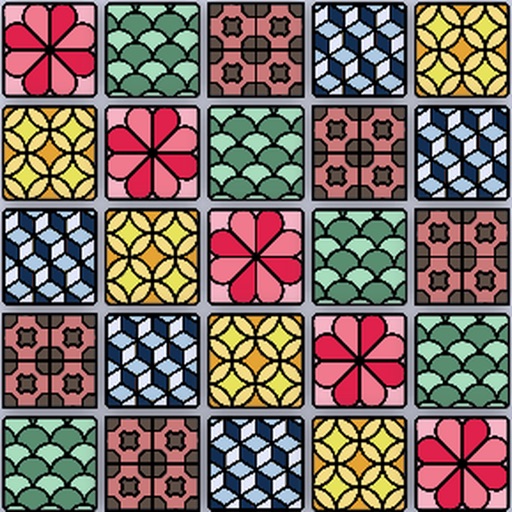
The visual presentation is superb. Tiles have a glossy, ceramic quality that catches the light as you drag them across the screen. The mosaic wall backgrounds feature authentic Portuguese tile patterns, and subtle particle effects accompany scoring moments. The colour palette is rich and carefully chosen to ensure each of the five tile colours is instantly distinguishable. On the audio front, the soundtrack is understated but fitting, with gentle ambient melodies that evoke a Mediterranean atmosphere. Tile placement produces a satisfying click sound, and scoring animations are accompanied by a melodic chime that rewards good play without becoming intrusive.
Monetisation Model
Azul follows a premium purchase model with no advertisements. The base game costs a one-time fee and includes the full classic Azul experience with AI opponents, local multiplayer, and online play. Expansion packs based on the physical board game expansions (Stained Glass of Sintra and Summer Pavilion) are available as optional in-app purchases. There are no loot boxes, energy systems, or pay-to-win mechanics of any kind. This consumer-friendly approach means you get the complete core experience from day one.
Pros
- Outstanding visual presentation with authentic tile aesthetics
- Multiple AI difficulty levels with genuinely challenging hard mode
- Smooth cross-platform online multiplayer
- Faithful recreation of the physical game's strategic depth
- Asynchronous play support for longer sessions
- Premium model with no ads or pay-to-win mechanics
Cons
- Occasional matchmaking delays in off-peak hours
- Colourblind mode was absent at launch (since patched)
- Expansion content sold separately as in-app purchases
- No single-player campaign or challenge mode
Final Verdict
Azul is the definitive mobile tile-strategy game. Its blend of visual polish, strategic depth, and excellent multiplayer infrastructure makes it a must-have for any strategy game enthusiast. Minor quibbles around matchmaking timing and paid expansions do little to diminish what is an outstanding digital adaptation of a modern board game classic.